


Artificial Intelligence and the Transformation of Scientific Congresses
Updated: Apr 14
From Information Delivery to Intelligent Knowledge Exchange

Artificial intelligence is rapidly transforming the way knowledge is produced, shared and interpreted across the global research environment. As these technologies become increasingly integrated into scientific practice, they are also beginning to reshape the organisation and functioning of scientific congresses.
For decades, congresses served primarily as platforms for the presentation and dissemination of research results. Scientific communities gathered periodically to exchange findings, discuss clinical experiences and build professional networks.
Today, however, the landscape of knowledge exchange has changed dramatically.
Digital communication, online publishing and collaborative research platforms allow information to circulate almost instantaneously. Artificial intelligence systems are increasingly able to analyse large volumes of scientific data, assist in literature reviews and support complex research processes.
In this new environment, the role of scientific congresses is evolving.
Rather than serving primarily as venues for the transmission of information, congresses are becoming spaces for interpretation, dialogue and strategic interaction within the research community.
Artificial intelligence may contribute to this transformation in several ways.
First, AI tools can support the organisation and analysis of large scientific programmes, helping organisers identify thematic connections between sessions, emerging research trends and interdisciplinary opportunities.
Second, intelligent systems may assist participants in navigating increasingly complex congress programmes by recommending sessions, speakers or topics based on their professional interests and research profiles.
Third, AI-driven language technologies — including real-time translation systems — are beginning to facilitate multilingual dialogue within international scientific meetings, making participation more accessible for researchers from different linguistic backgrounds.
These developments suggest that the future scientific congress may evolve into a more intelligent and interactive environment, where technology supports not only communication but also the discovery of connections between researchers, disciplines and ideas.
At the same time, the fundamental value of scientific meetings remains unchanged.
Scientific progress continues to depend on direct interaction between researchers, on informal conversations that generate new ideas, and on the creation of trust within professional communities.
Artificial intelligence can enhance these environments, but it cannot replace the human dimension of scientific dialogue.
The challenge for the future of scientific congresses will therefore be to integrate advanced technological tools while preserving the essential qualities that have always made scientific meetings effective platforms for collaboration.
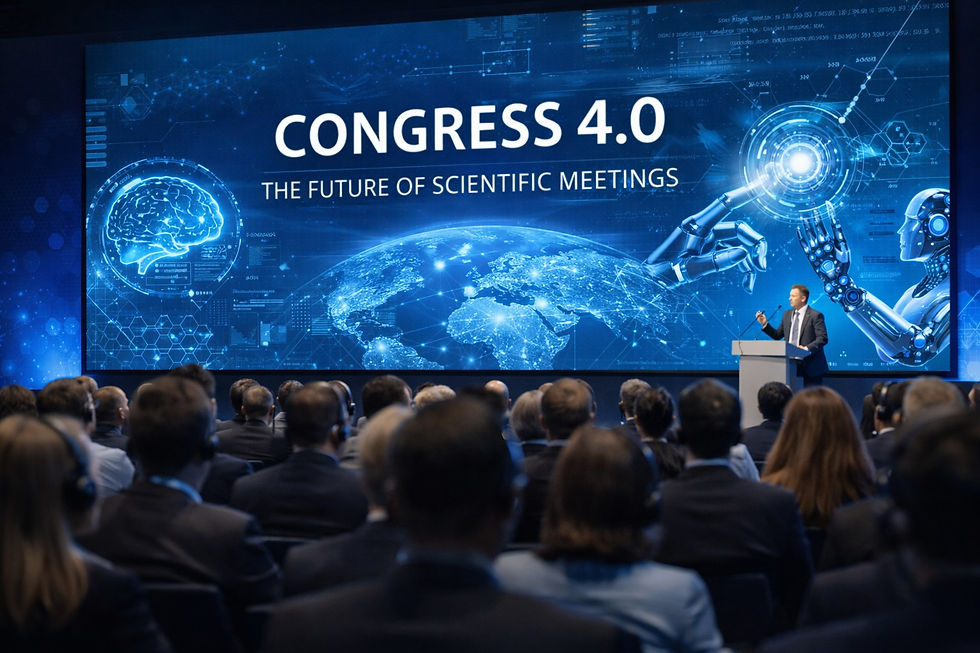
In this perspective, the transformation of congresses can be understood as part of a broader evolution — the transition toward what has been described as Congress 4.0, a model in which scientific meetings become complex ecosystems combining human interaction, technological support and global research collaboration.

This article is part of the Scientific Congress Insights editorial stream of the Congress Intelligence Journal, developed within the analytical framework of the Congress Intelligence Unit.
Association Days Europe
Association Days Europe brings together presidents and delegates of scientific societies with destinations and organisers involved in international congresses.
The event offers a space for dialogue on the evolving role of scientific meetings within the global research ecosystem.
Comments